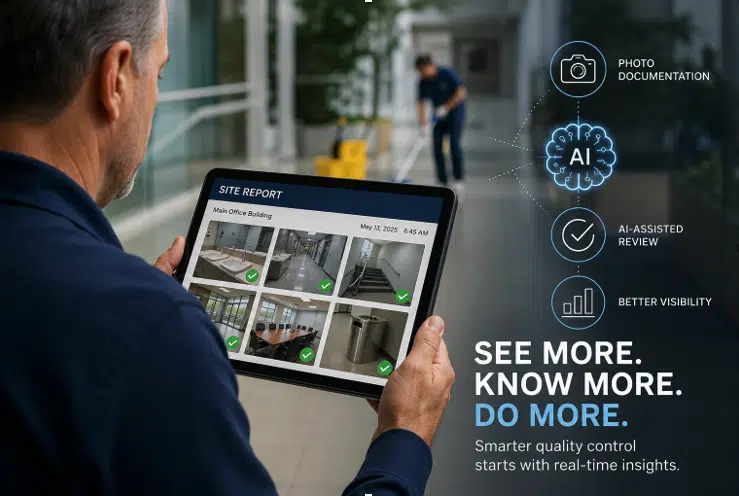
Most facility managers don’t have the time or the ability to watch every task being performed. Much of the work happens when no one is around, leaving managers to rely on inspections, reports and sometimes complaints to know whether expectations are being met.
From “Trust Us” to “Here’s the Evidence”
For commercial cleaning, this has traditionally been a particularly difficult problem. The work often happens after hours, in empty buildings, by people the client rarely sees. By the time managers walk through the building the next morning, they’re seeing the result, not the process.
For years, the primary way to discover that something was missed was to wait for someone to notice it. A restroom wasn’t cleaned properly. A conference room was overlooked. Someone brought a problem to a manager’s attention.
But what if quality control didn’t have to begin with a complaint? Photo documentation offers a different approach.
1. Document the Work
During service visits, dated and time-stamped photographs can provide a visual record of work being performed. Instead of relying entirely on a verbal assurance that the work was completed, management has something tangible to review. It’s a simple shift:
“We cleaned it” → “Here’s the evidence.”
2. Use AI to Review It
A photo is useful only if someone reviews it. When a cleaning operation involves dozens of locations and hundreds of photographs, that can become a significant task. This is where AI-assisted technology can add another layer of quality control.
AI can examine photo documentation and identify potential problems or discrepancies that may deserve a closer look. It might bring attention to an area that appears to have been overlooked or a detail that doesn’t appear to meet the expected standard. The technology doesn’t replace human judgment. Instead, it helps direct attention to the areas that may need it most.
3. Act on What You Find
The real value isn’t simply having photographs. It’s what happens when those photographs help identify a potential problem. An issue can be reviewed, addressed and corrected before it becomes a complaint.
That makes quality control more proactive. Instead of waiting for someone to discover a problem, the process provides another opportunity to catch it earlier.
Why It Matters
For facility managers, the value isn’t really about the technology itself. It’s about what the technology can provide:
- Visibility into work performed after hours
- Accountability without constant walkthroughs
- Consistency across shifts and locations
- Earlier identification of potential problems
- Documentation when a record of service is important
Cleaning has traditionally been judged by what someone sees when they walk through the building. That’s important, but it’s also a lagging indicator. It tells you what the building looks like at that moment, not necessarily how consistently the work is being performed.
Photo documentation, combined with intelligent review, provides another layer of quality control. As expectations around health, hygiene and accountability continue to rise, “trust us” is quietly being replaced by “see for yourself.”
At Frantz Building Services, we use photo-documented site reports and AI-assisted review as part of our quality-control process. It’s one more way we’re working to make cleaning quality more visible and accountable.